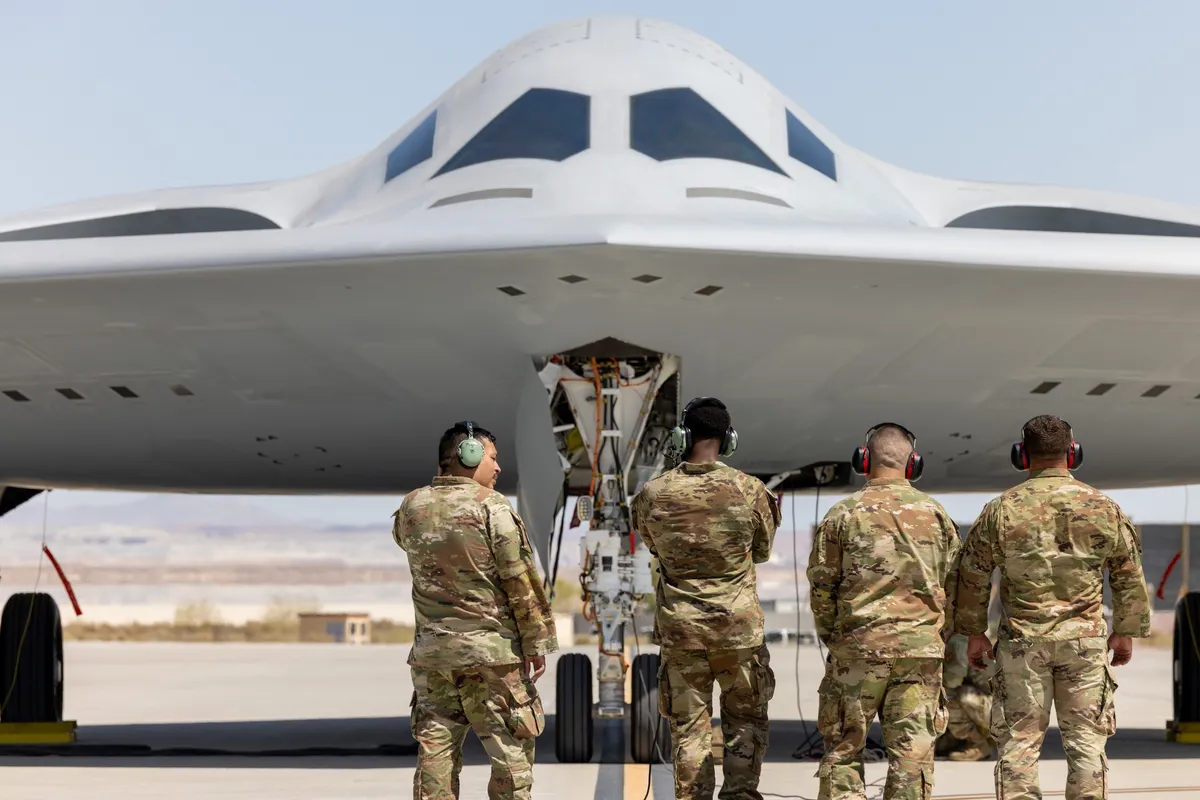
What the B-21 Means for Rapid City Commercial Real Estate
Ellsworth Air Force Base is in the middle of an estimated $2 billion construction effort to get ready for the B-21 Raider, the Air Force's new stealth bomber. The first aircraft are expected in 2027. If you own, lease or are thinking about buying commercial property in Rapid City, the question is simple: where will that growth show up, and how soon?
Here's what's confirmed, what it likely means for office, industrial and housing demand, and what we don't know yet.
Key takeaways
Ellsworth's B-21 construction effort is estimated at $2 billion. Two major buildings, a $161 million Low Observable Restoration Facility and an $81 million Wash Rack and General Maintenance Hangar, were accepted by the Air Force this year.
Ellsworth will be the B-21's first main operating base and home to its Formal Training Unit, the squadron that trains B-21 crews. The first aircraft are expected in 2027.
In September 2026, Elevate Rapid City announced an $18 million expansion of the Rapid City Innovation District, with Northrop Grumman, the company that builds the B-21, as the anchor tenant. The state's Future Fund is putting in $1 million.
The clearest effects on commercial real estate are office space for defense contractors, industrial and flex space for companies that support the base, and housing for the people moving here.
Current vacancy and rent figures for these property types aren't in the public reporting. Any decision should start with current local numbers.
What's actually happening at Ellsworth
Two finished buildings tell the story. The Low Observable Restoration Facility ($161 million) and the Wash Rack and General Maintenance Hangar ($81 million) were formally accepted by the Air Force in 2026. "Low observable" is the Air Force's term for stealth; that building is where the bomber's stealth coatings are maintained. These aren't plans. They're finished buildings for an aircraft that doesn't fly from any other base yet.
In September 2026, the Air Force activated B-21 Integration Detachment 1 at Ellsworth, a unit set up to coordinate the bomber's arrival. That's a sign the Air Force is adding people, not just buildings.
The order of events matters for real estate. Contractors and construction crews are already here. Defense company employees arrive ahead of the aircraft. Families decide where to live and work before the planes land. Demand for space usually shows up months, sometimes years, before the headline date.
Northrop Grumman is coming to downtown Rapid City
On September 23, 2026, Elevate Rapid City announced an $18 million expansion of the Rapid City Innovation District, next to the David Lust Accelerator Building in eastern downtown Rapid City. Northrop Grumman will occupy a new secure administrative building there. South Dakota's Future Fund is contributing $1 million, and the Ellsworth Development Authority another $1 million.
Elevate CEO Jack Valentine said Northrop's combined workforce at Ellsworth and the Rapid City office could eventually number in the hundreds. How many jobs will be in the downtown building hasn't been announced.
A company like Northrop does more than fill one building. Its suppliers, subcontractors and service companies tend to follow, because they need to be close to the work. That's how defense clusters grow: one anchor, then the companies around it.
Ellsworth sits east of Rapid City near Box Elder, and the Innovation District is less than 10 miles to the west. When you think about where demand will land, think about the corridor between the base and downtown, not just city limits.
Which property types stand to benefit
Office and industrial space for defense contractors
The most direct effect is demand from companies that support defense and aerospace work: contractor offices, specialized manufacturing, maintenance and logistics, engineering and cybersecurity. Many of these users want flex space, meaning buildings that combine offices with warehouse or light industrial space.
The open question for owners and investors is whether Rapid City's existing industrial and flex buildings can take on this demand or whether new construction will be needed. Current vacancy and asking rents for Rapid City industrial space aren't in the public reporting, so that answer comes from a current local market analysis, not a headline.
What is documented is the base Ellsworth already provides: an estimated 9,000 people in the area, including military members, their families and civilian employees, and an estimated $800 million a year in economic impact, according to South Dakota Searchlight's September 2026 reporting. The B-21 adds to that.
Workforce housing and apartments
Air Force Global Strike Command has said the B-21 beddown (the Air Force's term for moving a new aircraft and its people into a base) is increasing local needs for housing and infrastructure. The people who need places to live include military members and their families, civilian base employees, defense contractors moving to Rapid City, construction crews on multi-year projects, and the service workers who follow any large employer into a market.
Apartments and workforce housing near the Ellsworth corridor deserve a serious look. The demand case is well supported. What I'd caution against is projecting specific rents or lease-up timelines without current local data. The numbers need to come from Rapid City comparables, not national averages from other defense towns.
Retail, restaurants, hotels and services
More people, more technical and defense jobs, and more construction activity create demand for retail, restaurants, hotels and service businesses. That effect is real, but it follows the job and housing growth. If you own or are buying retail or hospitality property, treat B-21 growth as a tailwind, not the main reason the deal works.
Property type | What drives demand | Timing | Main risk |
|---|---|---|---|
Defense contractor office | Northrop Grumman anchor and its suppliers | Starting now, building through 2027 | Program delays or contractor changes |
Industrial and flex | Maintenance, logistics and manufacturing support | Starting now, through the construction years | Few existing buildings; new construction takes time |
Apartments and workforce housing | Military, civilian and contractor moves | Building now, ahead of the 2027 aircraft arrival | Permitting time and construction costs |
Retail, hospitality and services | More people and higher incomes | Follows housing and job growth | Depends on the main demand arriving on schedule |
Risks to keep in mind
Federal defense programs run on long timelines and depend on budgets, reviews and contracts that can change. The B-21 program is well underway, but no one should buy or build in Rapid City as if program risk is zero. The safer approach is to make sure a property works at today's demand and treat B-21 growth as upside.
Construction timing is another variable. The base buildout itself is keeping regional contractors busy. If you're planning new industrial or apartment construction, build extra time into your schedule.
Every property is different. The only way to know whether a specific building or site makes sense is to run the numbers with current local data.
Frequently asked questions
How will the B-21 affect demand for industrial space in Rapid City?
It's creating demand from defense contractors, aerospace suppliers, maintenance and logistics companies, and cybersecurity firms that support the Ellsworth mission. The Innovation District expansion, with Northrop Grumman as its anchor, is aimed at exactly these companies. Whether Rapid City's existing buildings can meet that demand depends on current vacancy and rent figures, which take a current local market analysis to pin down.
Is the Rapid City Innovation District a real opportunity for B-21 suppliers?
It's more concrete since the September 2026 announcement. The $18 million expansion is designed for companies working in national security and defense, and Northrop Grumman is the anchor tenant. When the prime contractor sets up an office, it tells its suppliers that Rapid City is a workable place to operate.
Will the B-21 create more demand for housing near Ellsworth?
The Air Force has said the B-21 beddown is increasing local housing and infrastructure needs, and the people driving that demand are already arriving. What isn't public yet are the unit counts, vacancy rates and rents you'd need to judge a specific apartment project. Start with current Rapid City comparables.
How long will construction at Ellsworth last?
The overall effort is estimated at $2 billion, two major buildings were accepted in 2026, and the first aircraft are expected in 2027. Programs this size usually build over several years, so demand for contractor labor, industrial space and housing isn't a one-year spike.
Which commercial properties could benefit most?
Defense contractor office space and industrial or flex space have the clearest support today, followed by workforce housing and apartments near the Ellsworth corridor. Retail, hospitality and services benefit as a second wave. The strongest cases are properties that serve defense and aerospace companies directly.
Thinking about a property near Ellsworth?
The B-21 is one of the biggest economic stories the Black Hills has seen in years, and its effect on Rapid City commercial real estate is still taking shape. If you're looking at a property or site in this corridor, get current local numbers before you commit. Call me at 605-430-7750 or book a time to talk. If you own commercial property in Rapid City and want to know how this shift affects its value, request a free property evaluation.
About Shannon Brinker
Shannon Brinker is the owner and broker of True North Asset Group, a commercial real estate brokerage in Rapid City, South Dakota. She is a licensed real estate broker and REALTOR with nine years of experience leasing and selling commercial real estate.
Shannon Brinker, Licensed Real Estate Broker, Brokerage License #17047. True North Asset Group, 510 N Cambell, Suite 2, Rapid City, SD 57701, 605-430-7750. This article is general information, not legal, tax or financial advice. Information is deemed reliable but not guaranteed and should be independently verified.
Sources
SecAF visits Ellsworth as base reaches historic B-21 Raider facilities milestone (Ellsworth Air Force Base)
Eighth Air Force activates B-21 Integration Detachment 1 (Air Force Global Strike Command)
Elevate Rapid City announces $18 million investment in Rapid City Innovation District (City of Rapid City)
State to help fund Rapid City office building for defense contractor Northrop Grumman (South Dakota Searchlight)
Featured photo: a B-21 Raider at Edwards Air Force Base, Calif., Sept. 11, 2025. U.S. Air Force photo by Kyle Brasier (DVIDS).
